
5 minute read
These past few days have been an emotional whirlwind. Our barn was hit with EHV1 - the neuro strain.
When the outbreak happened in November, I honestly didn’t think much about it. The states were all so far from us - TX, CO, NM, and I thought we were totally safe, nestled in the Midwest.
Our barn went on a 30-day lockdown as a precaution anyway. All of our horses are healthy, our barn is clean, and we are states away from affected states.
And then we lost an incredible horse, and the test came back positive. And the blurry-vision-shaking-hands panic set in. The thought of losing my horses is too much to handle.
I’ve spiraled on every instance of possible cross-contamination I put my horses in the last week. I’ve spent hours and hours reading articles on EHV and trying to understand it. I’ve looped on wondering what could cause this, how it got here, and what/if could have carried it.
I started thinking of all of the people who come in and out of the barn - could they have carried it on their tools?
The cause of this instance is unknown, as there are no known cases in our area. All I know is it’s an absolute nightmare for a barn owner and horse owners.
And this whole thing has opened my eyes to how incredibly nonchalant I am about biosecurity as an equine practitioner. Biosecurity is something I never fully appreciated, because honestly - I didn’t have to.
Horses are healthy. Barns are clean. Everything is fine. (Until it’s not, I’m learning.) Of course, I wash my hands between barns and try to get ‘cleaned up’. But what about the muck on my block, or the dirt and horse hair on my tools?
I’ve realized that biosecurity isn’t just a “show barn problem” or something to only think about during an outbreak. It’s a responsibility I share at all times. It’s a responsibility that travels with me from horse to horse and barn to barn.
That uniquely positions me to either help stop the spread of disease… or unintentionally contribute to it.
I can’t prevent everything, but I can know that I played my part in keeping beloved client’s horses safe. Diseases (like EHV-1) can spread like wildfire through horse herds and barns, sometimes with devastating consequences, as we’ve experienced.
As practitioners, strong biosecurity practices protect not only the horses we serve, but also our clients’ barns, our livelihood and reputation, and the industry as a whole.
A single missed hand wash or shared piece of equipment can be enough to move a virus from one barn to another. Many equine diseases are spread either through direct contact (horse-to-horse) or indirect contact (equipment, clothing, hands, trailers, stalls, cross-ties, grooming tools, etc.) Some pathogens can survive on surfaces for hours, or even days or weeks, making cross-contamination surprisingly easy for them and a nightmare for us.
When traveling to multiple locations, indirect contact biosecurity isn’t optional - it’s our due diligence.
Clients trust us with their horses’ well-being. That trust extends beyond the session and includes the unseen steps we take to protect herd health. When we up our biosecurity practices, we:
Protect vulnerable horses like seniors, babies, and immunocompromised
Reduce barn-wide shutdowns and quarantines (which suck big-time)
Build confidence with our clients
Show our leadership in the horse community
Plus, biosecurity doesn’t have to be complicated or expensive.
Here are the few extra steps I’m adding to my routine, or making sure to do all the time, not some of the time.
1. Wash Hands (non-negotiable)
This is a step I always do between barns and try to do between horses. From now on, I will be:
Washing my hands with soap and water between horses (not just barns) whenever possible
I'll use alcohol-based hand sanitizer when washing isn’t available
I’ll scrub my hands + arms in between all barns.(even if it means stopping at a gas station)
2. Disinfect Equipment
I’ve always viewed this as a “cleaning day” rather than an “all the time” thing.
From now on, I will be:
Bringing a bottle of alcohol spray to wipe down all my tools between appointments
This includes wiping down my phone!
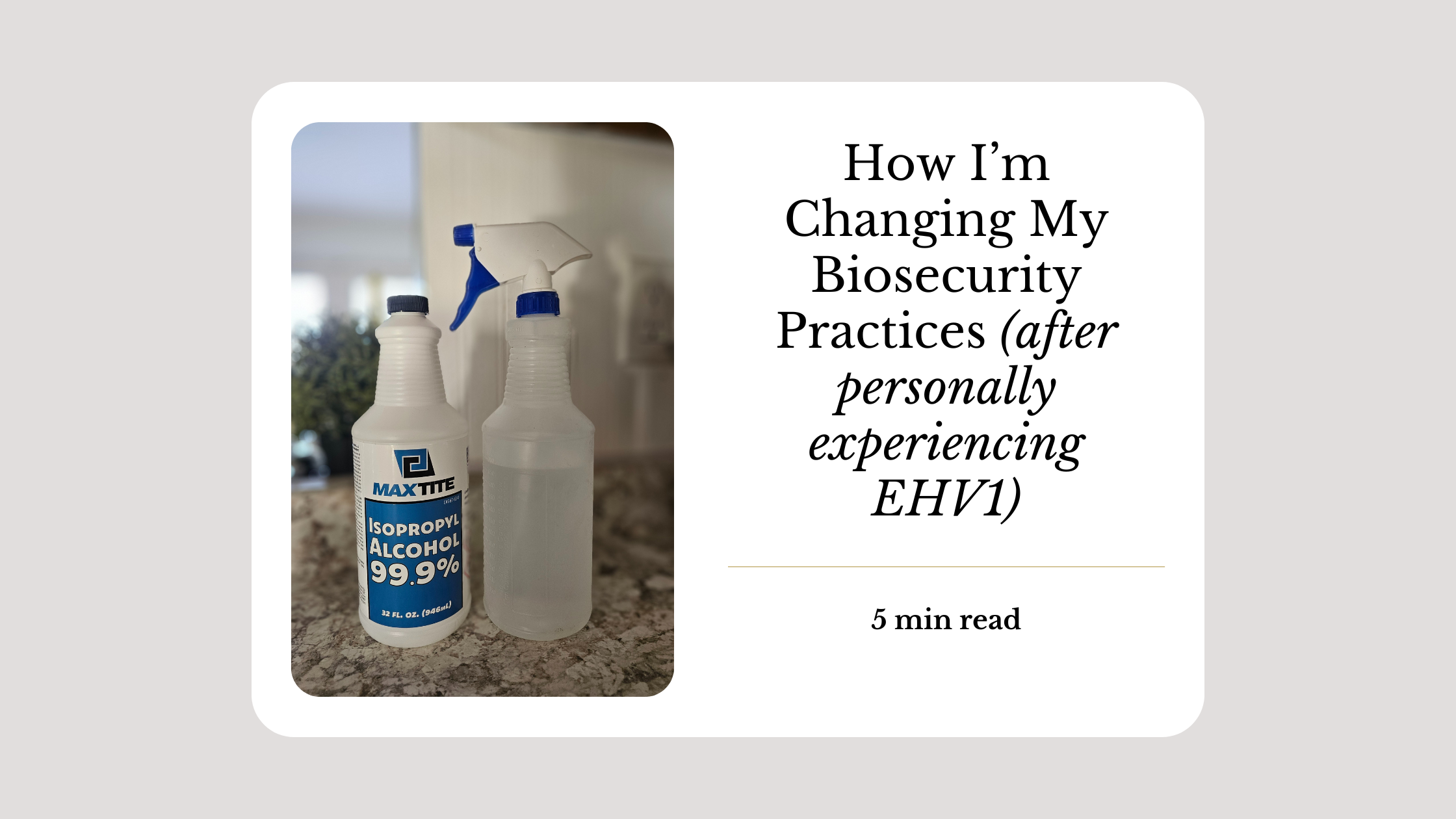
My husband made me this alcohol spray.

It’s 99.9% Isoprophy Alcohol mixed with water to cut it to a 70% ratio so it doesn’t evaporate too fast before disinfecting. It also doesn’t stain your clothes like bleach! Also using disposable towels, rather than cloth, is more biosecure. If you’re looking for a more eco-friendly option, there are bamboo paper towels!
3. Wear Clean Clothes
This is easy in the summer, I’m sweaty and won’t reuse clothing. But in winter, I wear the same coveralls multiple times before washing. From now on, I will be:
Wearing only clean, freshly washed clothing to the barn - including jackets and outerwear - and no longer wearing them multiple times to multiple places before washing
Spraying a virucidal disinfectant (like my alcohol spray) on my shoes between barns as well
I’ll have a separate pair of work boots and barn boots
4. Vehicle Biosecurity
I’ll store all my tools in my truck bed, and spray it down at the end of the day
If things need to be washed, I’ll have a separate bin or bag to throw it into and keep it separate and contained
I’ll wipe down my steering wheel at the end of the day
5. Policies and Client Communication
I’ve confirmed my Policies and Consent includes a section on recent illness, fevers, or quarantines before appointments
I’ll add that section of the policy on my website
I’ll be open and educate clients about biosecurity, why these precautions matter for their horses, and steps they can take at shows
Conclusion
I’ve always felt a bit of a germaphobe, so maybe things won’t be too different. It will probably look like more of what I’m already doing - washing my hands, wiping down my tools. I’ll ditch my microfiber clothes for bamboo paper towels. (And I think alcohol spray is my new best friend.)
But I’ll carry the knowledge of the importance of biosecurity with me, and the intention of implementing it well.
Biosecurity is an act of respect - for the horse in front of me, the horses down the aisle, the barn down the road, and the equine community. By taking intentional, consistent steps to reduce cross-contamination, I can help protect the animals I’m here to serve.
Have any questions? Feel free to ask! I know this is a heavy topic, and I’m happy to share what I’ve learned this past week.
P.S. - My boys are doing good. I think they’re going to be okay!

